
Article
Eataly's Loyalty Card in a Market of 3.4 Loyalty Cards
82% of grocery shoppers already belong to a loyalty program, and the average member juggles 3.4 of them. Eataly's Amici program earns real loyalty through free coffee and birthday discounts—but a card you sign up for at a desk is competing against a wallet pass you tap in three seconds.
- Published
- February 27, 2025
- Updated
- June 18, 2026
- Reading time
- 8 min

2026 updated analysis
What changed since the original article
This page keeps the original Transformidy article as the canonical record and leads with the current interpretation, source notes, and Revenue Unknown framing.
The Saturation Problem
82% of grocery shoppers already belong to at least one loyalty program, and the average member now belongs to 3.4 programs in the grocery category alone—a 47% increase since 2023. Eataly's Amici card, whatever its merits, is not entering an empty field. It is the fourth or fifth card in a customer's rotation, competing for attention against programs the customer already has muscle memory for.
That saturation is showing up in the numbers that matter more than enrollment. Only 59% of enrolled members use their grocery loyalty program on a regular basis—a 27-point gap between the share of consumers who say loyalty matters to them and those who actually use their program. And across retail categories, grocery scored an influence rating of 39.2 out of 100, the lowest of any category, despite having the most total loyalty members of any sector. Grocery loyalty has won the enrollment war and is losing the attention war.
Gap between shoppers who say grocery loyalty matters and those who actually use it regularly
82% enroll. Only 59% use their program regularly. The gap is where enrollment stops meaning anything.
The Enrollment Friction Gap
Eataly Amici's mechanics are genuinely fair: 2.5 points per dollar spent, a free café drink and 500 bonus points at signup, cardholder-only sale pricing, and a 20%-off birthday discount once a year. None of that is the problem. The problem is how a customer joins: signing up in person at the Guest Relations desk with valid identification—a desk visit, in a market where competing programs are one tap away.
Research on specialty and health food retailers quantifies exactly how much that friction costs: wallet pass programs reached 60-70% customer adoption within three months, compared to roughly 15% adoption for standalone loyalty apps that require a separate download. A physical card requiring a desk visit sits on the far friction end of that same spectrum—generous terms cannot compensate for an enrollment step most customers will simply skip.
The payoff for solving this is not abstract. The same research found loyalty members retaining at an 82% annual rate versus 63% for non-members, and during a period of food price inflation, loyalty-enrolled stores retained 85% of customers versus 72% for stores without an active program—a 13-point buffer against customers trading down to cheaper alternatives. For a premium-priced specialty grocer, that inflation-period buffer is the entire business case for fixing enrollment friction.
Desk-Signup Card vs. Wallet-Pass Enrollment
Same rewards. Radically different adoption curve.
Desk signup: ID required, in-store only, a visit most customers postpone indefinitely. Wallet pass: added from checkout or a QR code in under a minute, no separate app download, no desk visit.
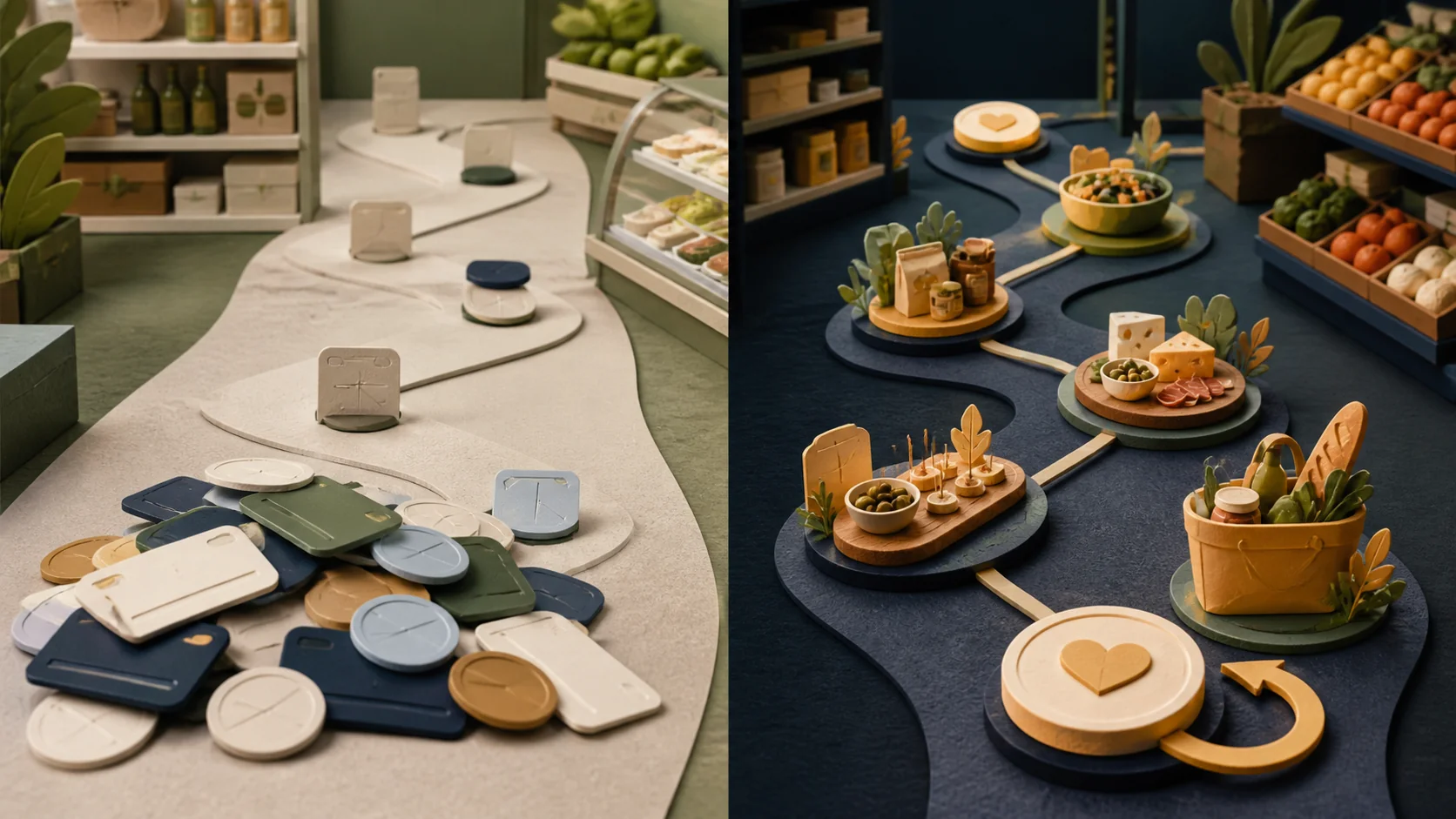
A loyalty program does not compete on points value anymore. It competes on how many seconds it takes to join.
The Leadership Move
The structural choice is whether to keep measuring loyalty program success by enrollment count, or to measure it by regular-use rate and defend the enrollment mechanism itself as a conversion funnel with its own friction to eliminate.
- Ownership
Marketing owns program design and rewards; store operations owns the physical enrollment experience; digital/IT owns whether a wallet-pass or app-based alternative exists at all. When enrollment friction sits entirely with store operations and nobody owns removing it, a generous program stays generous and stays unused.
- Tradeoff
Building a wallet-pass or app-based enrollment path requires a real technology investment for a specialty grocer that may only operate a handful of locations. The alternative is a loyalty program with strong terms and, per the sector data, a large gap between who joins and who ever redeems—paying for benefits that never influence the majority of enrolled members' behavior.
- Human consequence
A customer who wanted to join at the register but was told to visit Guest Relations instead often never returns to complete that step—not because the program was not worth it, but because the moment of interest passed. Staff see this as a customer declining loyalty; it is usually a customer declining the errand.
Next Move
If your loyalty enrollment still requires a desk visit or ID check: Add a wallet-pass or QR-based path that lets a customer join from checkout in under a minute. The sector data shows this single change moves adoption from roughly 15% (app-download equivalent) toward 60-70% within three months—a bigger lever than any change to the points formula itself.
If your program already has strong enrollment numbers: Report regular-use rate alongside enrollment, not instead of it. The 27-point gap between "shoppers who say loyalty matters" and "shoppers who use their program regularly" is the number that determines whether your loyalty investment is protecting margin during the next price-inflation cycle or just sitting in a drawer.
FAQ
Do grocery loyalty programs still work?
They still drive retention, but their behavioral influence has fallen relative to other retail categories. Industry research puts grocery's influence score at 39.2 out of 100—the lowest of any category measured—despite grocery having the most total loyalty members of any sector. The programs exist; fewer of them are changing what people actually buy.
How many loyalty programs does the average grocery shopper belong to?
82% of grocery shoppers belong to at least one loyalty program, and the average member belongs to 3.4 programs in the grocery category alone—a 47% increase since 2023. Only 59% of enrolled members use their program regularly, a 27-point gap between stated importance and actual use.
What is the actual difference between a wallet pass and a physical loyalty card?
Enrollment friction. Signing up for a physical card requires a desk visit, an ID, and a wait; adding a wallet pass takes seconds on a phone already in the customer's hand. Research on specialty and health food retailers found wallet pass programs reaching 60-70% adoption within three months, versus roughly 15% for standalone loyalty apps that require a separate download.
Does loyalty program enrollment actually protect a specialty grocer during price inflation?
Yes, measurably. One analysis of health food and specialty retailers found stores with active loyalty programs retained 85% of customers during a period of food price inflation, versus 72% for stores without a program—a 13-point buffer against customers trading down to cheaper alternatives.
Sources & References
Original article archive
Original article published February 27, 2025: "Eataly Canada's New Amici Perks Program: A Recipe For Success". Preserved here for provenance, historical context, and citation continuity.
Eataly Canada, a destination for Italian food enthusiasts, has introduced the Amici Perks Program, a customer-centric initiative aimed at enhancing brand loyalty and enriching the shopping experience. By offering exclusive perks, rewards, and discounts, Eataly seeks to strengthen its relationship with its customers while standing out in the competitive Canadian food retail market.
Key Takeaways
- The Amici Perks Program offers customers 2.5 points per Canadian dollar spent, redeemable for discounts on future purchases.
- Perks include a welcome bonus, birthday discounts, and exclusive pricing on select items.
- While the Amici Perks Program enhances customer engagement and promotes spending, limitations such as restaurant exclusions and redemption thresholds may hinder its full potential.
Introduction: Eataly Canada – A Culinary Haven
Eataly Canada is more than just a marketplace; it’s an immersive culinary experience. Opened in 2019 with significant fanfare, the chain is known for its high-quality Italian-focus groceries, dining options, and educational events. Over the past five years, Eataly Canada has established itself as a hub for food lovers seeking authentic Italian flavors, groceries, and cooking tools. Currently, the chain has three permanent and one seasonal locations in Toronto, Canada. Two highly anticipated locations (Montréal and Toronto Eaton Centre) will open in March and Fall 2025 respectively.

Eataly Canada combines retail and hospitality to create a unique shopping and dining experience. To further engage its loyal customer base, Eataly has launched the Amici Perks Program, reflecting its commitment to rewarding patrons who share a passion for Italian groceries.
The Eataly Canada Amici Perks Program: In Detail
The Eataly Amici Perks Program*, "amici" being Italian for friends, is designed to reward loyal customers and foster a deeper connection with the brand. It is free to join, and members earn 2.5 points for every Canadian dollar spent in the marketplace area. Once 2,000 points are accumulated, members can redeem up to CDN$20 off their grocery bill. *terms and conditions and privacy policy

The Amici Perks Program is a simple to use program that rewards shoppers who spends money at the marketplace.The return rate taking into account the new member bonus is 3.33% for the first CDN$20 of redemption and 2% afterward. The following is a list of the program's key pros and cons:
Pros:
- Welcome Bonus: New members receive a free coffee and 500 bonus points upon signing up at the cashier desk.
- Special Prices: Cardholders gain access to exclusive discounts on selected items via the Eataly newsletter.
- Birthday Gift: Members receive a 20% discount on their entire market purchase during their birthday month.
Cons:
- Restaurant Exclusion: Points cannot be earned or redeemed at Eataly's restaurants.
- Redemption Threshold: The 2,000-point minimum for redemption might take some time to reach for infrequent shoppers.
- Marketplace Only: The benefits are limited to the marketplace and do not extend to online purchases or other Eataly experiences.
Note that In the United States, Eataly runs a separate program called the Ambassador Loyalty Program. While these two programs share the same features, they are not interchangeable currently and require separate registration at a local store.
Loyalty Program and Customer Experience Implications
Loyalty programs are powerful tools for enhancing customer experience (CX) and driving repeat business. By offering exclusive rewards and personalized experiences, companies can foster a sense of appreciation and loyalty among their customer base. In fact, studies show that loyalty program members spend up to 18% more annually compared to non-members (Accenture, 2022).
For Eataly Canada, its Amici Perks Program has the potential to create a more engaging and rewarding shopping experience, encouraging customers to return and spend more. However, the program's success hinges on how well it meets customer expectations and addresses potential pain points. The exclusion of restaurant purchases, for example, could be a significant drawback for customers who frequent Eataly's dining options.
Competitive Analysis
The grocery and specialty food market in Canada is competitive, with numerous players vying for customer attention. Competitors like Pusateri's Fine Foods and Whole Foods Canada also offer loyalty programs or personalized shopping experiences. Pusateri's offers a loyalty program with points-based rewards and exclusive perks. Whole Foods Market relies more on its reputation for high-quality products and a unique shopping experience to drive customer loyalty. To stand out, Eataly needs to ensure its Amici Perks Program offers compelling value and a seamless experience. This could involve offering more personalized rewards, expanding the program to include restaurant purchases, or integrating it with Eataly's online platform along with partnering with a bank for a branded credit card.
Key Success Factors
Introducing a loyalty program does not automatically guarantee success. Consumer expectation, spending upticks, and personalization are key themes for retailers to consider. There are several factors that could determine the success of the Eataly Canada Amici Perks Program:
- Clear Communication: Eataly Canada must effectively communicate the program's benefits and terms to customers. How can customers earn and redeem points?
- Easy Enrollment: The sign-up process should be simple and convenient. How many customers enroll into the program and become active users?
- Relevant Rewards: The rewards offered should be appealing and relevant to Eataly Canada's target audience.
- Seamless Integration: How is the program seamlessly integrated into the overall Eataly experience.
- Data Utilization: What type of data does Eataly Canada leverage to personalize rewards and offers. How is privacy managed if personal data is accessed and used?
Future Innovations and Next Steps
The Amici Perks Program is easy to understand and use. Transformidy notes that It will gain traction with shoppers. To maximize the engagement and revenue impact of the program, Eataly Canada should consider these innovations:
- Tiered Program: Introduce a tiered status system with increasing "perks" for higher spending levels.
- Personalized Offers: Use data to personalize offers based on individual customer preferences and past transactions.
- Communication: Improve in-store and online communication on the program and the program's benefits (e.g., signs and social media posts). Create an Amici Perks Program launch event to drive external media amplification and customer engagement.
- Restaurant Integration: Expand the program to include restaurant purchases and rewards.
- Digital Integration: Develop a mobile applications or online portal for easy tracking of points and rewards.
- Partnerships: Partner with other Italian brands or businesses to offer exclusive benefits to Amici Perks Program members (i.e., co-branded credit card), a store at the Toronto Pearson International Airport, Italian film festival integration).
Transform for the Better
The Eataly Canada Amici Perks Program represents a significant step towards building stronger customer relationships and driving loyalty. By focusing on clear communication, relevant rewards, and continuous improvement, Eataly can transform the program into a powerful tool for enhancing customer experience and achieving sustainable growth. Embracing innovation and listening to customer feedback will be crucial to ensuring the Amici Perks Program remains a valuable asset for both Eataly Canada and its loyal patrons.
FAQ Section (Updated as at February 27, 2025)
How do I sign up for the Amici Perks Program?
Visit the Guest Relations desk at your local Eataly store with valid identification to enroll.
Is there a fee to join?
There is no fee joining the Amici program is completely free.
How do I earn points?
Earn 2.5 points per dollar spent at participating Canadian Eataly stores by presenting your member card at checkout.
Can I use my points at restaurants?
No, points are currently limited to marketplace purchases only.
What happens if I return an item?
Points earned from returned items will be deducted from your account balance.
Do my points expire?
Yes, points expire 365 days after they are earned if not redeemed.
How Transformidy Can Help?
At Transformidy, we specialize in helping brands navigate the complex world of maximizing customer experience for improved engagement, satisfaction, and business growth. Our team of experts can assist you in assessing, tailoring, and implementing the right customer experience strategy for your company.
Contact us or set up a 30-minute complimentary consultation for more information on our services, insights, or showcases. We look forward to hearing from you.
FAQ
Do grocery loyalty programs still work?
They still drive retention, but their behavioral influence has fallen relative to other retail categories. Industry research puts grocery's influence score at 39.2 out of 100—the lowest of any category measured—despite grocery having the most total loyalty members of any sector. The programs exist; fewer of them are changing what people actually buy.
How many loyalty programs does the average grocery shopper belong to?
82% of grocery shoppers belong to at least one loyalty program, and the average member belongs to 3.4 programs in the grocery category alone—a 47% increase since 2023. Only 59% of enrolled members use their program regularly, a 27-point gap between stated importance and actual use.
What is the actual difference between a wallet pass and a physical loyalty card?
Enrollment friction. Signing up for a physical card requires a desk visit, an ID, and a wait; adding a wallet pass takes seconds on a phone already in the customer's hand. Research on specialty and health food retailers found wallet pass programs reaching 60-70% adoption within three months, versus roughly 15% for standalone loyalty apps that require a separate download.
Does loyalty program enrollment actually protect a specialty grocer during price inflation?
Yes, measurably. One analysis of health food and specialty retailers found stores with active loyalty programs retained 85% of customers during a period of food price inflation, versus 72% for stores without a program—a 13-point buffer against customers trading down to cheaper alternatives.
Related intelligence
Article
BMO Killed a Brand That Reached Two-Thirds of Canadian Households
AIR MILES reached roughly two-thirds of Canadian households over 34 years. BMO bought it for $160 million in 2023 and retired the name three years later. Every point converted automatically. The brand did not.
Article
STARLUX's Fastest-Growing Business Is Not Passengers
STARLUX's cargo revenue grew 44% in November 2025, driven by the global AI server shipment boom. The airline's most interesting growth signal in 2025 was not a themed passenger campaign. It was air freight for data center hardware.
Article
Retail Banking CX: Digital Convenience vs. Human Trust
Retail banks deployed digital-first strategies and automated advice, but discovered that convenience without accountability erodes customer trust. Successful banks built digital channels that preserved human judgment and financial responsibility.