

BMO’s Blue Rewards marks a pivotal reset of the AIR MILES era in Canada, reframing coalition loyalty for a market that is both saturated and more selective than ever about which programs earn a place in daily life. For CX leaders, this is more than a points migration; it is a live case study in how to transform for better in an environment where loyalty is earned through relevance, simplicity and financial impact, not only brand nostalgia.
Table of Contents
Key Takeaways
- Blue Rewards marks a strategic reset of the legacy AIR MILES program, simplifying the earn and redeem experience into a single, clearer currency.
- The automatic conversion of existing Miles to Blue Points is designed to preserve value and protect trust while reducing anxiety about program change.
- Success will depend on delivering a truly digital‑first experience, with clear visibility into points, value and progress across web, app and banking channels.
- In an intensely competitive Canadian loyalty market, Blue Rewards must demonstrate everyday financial impact that can stand up to PC Optimum, Scene+, Aeroplan and membership ecosystems like Prime.
- Partner selection and integration will shape customer perception; the coalition needs to match real shopping and travel journeys, not just claim a large partner count.
From AIR MILES to Blue Rewards: Context and Catalyst
For three decades, AIR MILES was Canada’s iconic coalition program, with partners across fuel, grocery, retail and travel, and nearly five million active loyalty customers by 2024. The model enabled collectors to earn Miles with many brands and redeem for travel, merchandise and everyday rewards, but it also created complexity through multiple Mile types, shifting partner rosters and uneven perceived value.
BMO acquired the AIR MILES program out of creditor protection, then spent the following period stabilizing the brand, rebuilding co‑branded card engagement and simplifying the proposition. Strategy data shows that after the acquisition, Air Miles saw a “significant upswing” in performance, but faced regional headwinds in Québec as major merchants such as RONA, Jean Coutu and IGA exited the coalition. In parallel, Canadian consumers were enrolled in an average of 19 loyalty programs in 2024, but only used about seven regularly, underscoring both loyalty fatigue and the imperative for sharper value propositions.
The launch of Blue Rewards in summer 2026 is positioned as a bold reimagining of the legacy AIR MILES program, operated by a BMO subsidiary and designed to deliver a more seamless, personalized and financially meaningful experience. This shift happens against a backdrop where 27 million Canadian adults, or 82 percent of the population, use loyalty programs weekly, making the competitive bar for relevance exceptionally high.
What Blue Rewards Changes
Blue Rewards is not a cosmetic rebrand. It rebuilds the underlying experience architecture around simplicity, flexibility and digital enablement.

Structural and functional shifts
- All existing AIR MILES will convert automatically to Blue Points at equivalent value in summer 2026, with no action required from collectors, which directly tackles anxiety around breakage or devaluation.
- Cash and Dream Miles, historically a source of confusion and decision friction, are consolidated into one simple point currency, reducing mental load and improving perceived fairness.
- Members gain a streamlined travel redemption platform for flights, hotels and car rentals powered by Expedia Group, aligning Blue Rewards with the travel‑first orientation of leading programs while keeping the familiar earn‑everywhere coalition DNA.
- The program plans to work with more than 400 brands across Canada, which preserves coalition scale while creating room for new partners and experiences.
- Instacart, Porter Airlines and Accor Brands such as Fairmont and Novotel will be key featured merchants for the new rewards program. Their popularity across Canada will fuel improved traffic and engagement for the program.
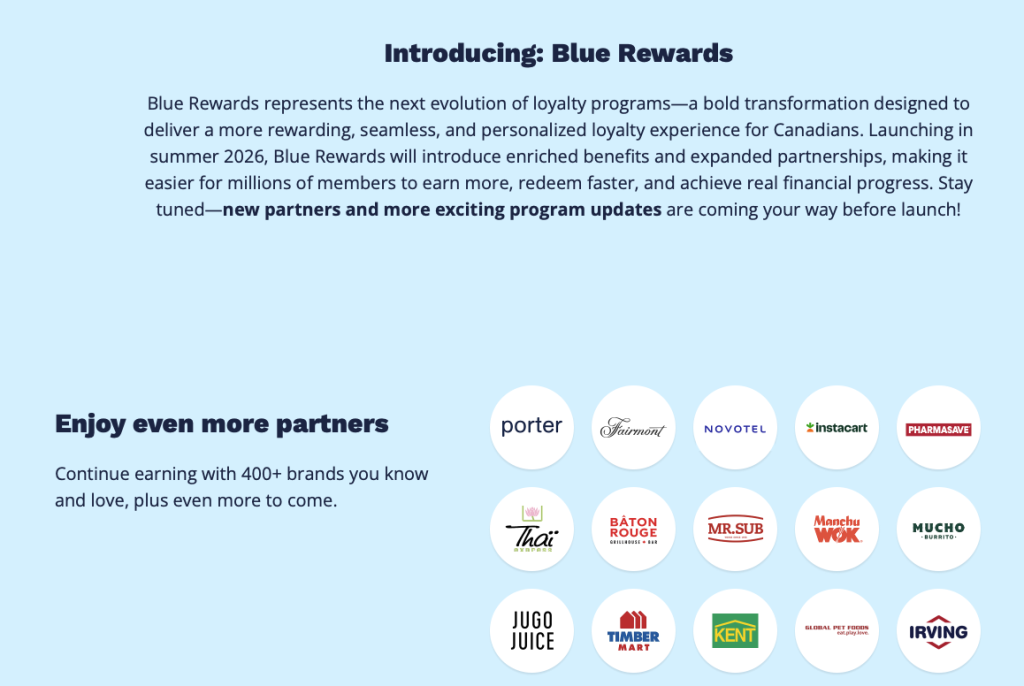
Shell Canada will remain a key partner in the short term, with earn and redeem continuing nationally through May 25, 2026 (earlier in Alberta), signaling to collectors that core everyday categories like fuel still matter during the transition. BMO AIR MILES credit and debit cardholders can continue to use their cards uninterrupted, with full details of the Blue Rewards linkage to come, which protects established payment behaviors while BMO repositions its card portfolio around the new program.
Given its tight integration with BMO, it is possible that the the Blue Rewards program will cut ties with American Express Canada.
Experience promise
BMO’s public narrative emphasizes a more rewarding, seamless and personalized journey, with a digital experience that allows members to earn, redeem and see their financial progress more clearly. With 42 percent of Canadians already preferring digital loyalty cards in 2024 (up from 32 percent in 2023), the pivot toward a streamlined digital interface is both necessary and timely. The Blue Rewards positioning, anchored in “real financial progress,” acknowledges that in an inflationary environment, collectors want loyalty programs that act as everyday financial tools, not just aspirational travel vaults.
Competitive Landscape: Where Blue Rewards Must Win
Canada is one of the world’s most competitive loyalty markets, with several programs operating at national scale and strong category ownership. To understand the CX stakes for Blue Rewards, it helps to compare its context against key players.
Leading Canadian loyalty programs
In this field, Blue Rewards must prove that a coalition model can still compete with vertically integrated ecosystems that blend payments, content, and everyday utility. While PC Optimum and Scene+ focus on frictionless earn on essentials, Aeroplan concentrates on outsized travel value and transfer strategies, and Amazon Prime wraps benefits around a subscription and a dominant ecommerce platform.
For BMO, the strategic opportunity is to position Blue Rewards as the best of both worlds: everyday, coalition‑style earn with a modern, travel‑ready redemption engine and a financial‑wellbeing storyline tied to banking products. To achieve that, the customer experience must be auditable, transparent and emotionally resonant, not merely rich in features.
CX Implications: Risks, Moments of Truth and Design Opportunities
Transforming from AIR MILES to Blue Rewards builds in multiple high‑risk, high‑impact customer journeys. These journeys will shape how collectors, partners and competitors interpret the move.
Critical CX risks
- Trust in value equivalence: Although BMO has committed to converting all Miles to Blue Points at equivalent value, any perceived devaluation or confusion at launch could erode trust quickly in a market where consumers are already selective about which programs they actively use.
- Transition friction: Even with automatic conversion, members will need to understand new rules, benefits and interfaces. Poor onboarding journeys, unclear messaging or broken digital flows could trigger attrition to rival programs such as PC Optimum, Scene+ or Aeroplan.
- Partner churn and perception: With Shell’s established exit timing and prior partner exits in Quebec, collectors will watch closely to see which brands populate the promised network of 400 plus partners and whether those partners match their real‑life baskets and travel needs.
Experience design opportunities
- Orchestrated transition storytelling
A program migration at this scale is both operational change and emotional narrative. Transparent, multi‑wave communication that shows examples of “old Miles to new Blue Points” scenarios in dollar value terms will be essential for confidence. In‑app visualizations of progress (“what your points are worth today,” “how much you saved in the last 90 days”) can transform an abstract rebrand into a concrete sense of gain. - Hyper‑relevant digital and mobile journeys
With nearly half of Canadians already preferring digital loyalty cards, Blue Rewards has a permission space to lead with digital‑first experiences, not treat them as a digital replica of plastic cards. This includes contextual offers at checkout, real‑time points visibility across BMO banking channels, and tailored redemption prompts at moments of financial strain (for example, nudging grocery redemptions when inflation spikes). - Personalization that respects cognitive load
Canadians belong to an average of 19 programs but only use seven regularly, which means every additional email, notification or in‑app banner competes with a noisy loyalty landscape. The most powerful personalization will not be the most complex; it will be the most contextually appropriate, ideally framed around a small set of “jobs to be done” such as saving on fuel, closing a travel gap or completing a household purchase. - Partner ecosystem as CX stage, not backdrop
The stated ambition to work with 400 plus brands gives Blue Rewards an opportunity to choreograph cross‑partner experiences rather than list individual earn rates. For instance, curated “Blue Journeys” that connect grocery, fuel, travel and financial services into coherent paths (back‑to‑school, family vacation, new‑home setup) would give the coalition model a narrative edge over single‑ecosystem competitors.
Transform for Better: A CX Agenda for Loyalty Leaders
Blue Rewards encapsulates a moment that many loyalty leaders face: legacy structures that still carry emotional weight, but no longer reflect how customers move through channels, partners and financial realities. The shift from AIR MILES to Blue Points is a visible example of how to modernize without erasing the past, and of how fragile trust can be in the process.
For organizations beyond BMO and Air Miles Group, this is a timely signal to reassess whether loyalty programs are truly pulling their weight as engines of customer value, data insight and brand differentiation. In a market where 82 percent of adults use loyalty programs weekly and program fatigue is rising, standing still is, itself, a CX risk.
Call to action for CX and loyalty teams
Now is the moment to transform for better. Use the Blue Rewards announcement as a catalyst to:
- Audit your current loyalty program for clarity, fairness and perceived value across the entire lifecycle, not just earn rates.
- Map the emotional journey of your members during change moments such as partner exits, currency changes or app redesigns, and design for reassurance, not just compliance.
- Benchmark against leading programs (PC Optimum, Aeroplan, Scene+, Prime) on digital experience, personalization and everyday financial impact, then deliberately choose where you will differentiate.
- Reframe loyalty from a points ledger into a strategic CX asset that supports financial wellbeing, reduces friction and creates signature experiences across partners and channels.
10‑question FAQ
- What is Blue Rewards?
Blue Rewards is BMO’s new loyalty program that replaces the legacy AIR MILES structure with a simplified, modern points experience focused on everyday value and travel. - What happens to my existing AIR MILES?
Existing Miles are intended to be converted automatically into Blue Points at an equivalent value, so collectors keep their accumulated rewards under the new program. - Do I need to re‑enroll in the new program?
In principle, current AIR MILES members are migrated into Blue Rewards, with no new enrollment step required beyond accepting updated terms and accessing the new digital experience. - How is Blue Rewards different from the old AIR MILES program?
Blue Rewards consolidates multiple Mile types into a single point currency, emphasizes a streamlined travel redemption platform and aims for a more intuitive digital and mobile journey. - Will my BMO AIR MILES credit card still work?
Yes, your card continues to function, and the earn structure will be aligned with Blue Rewards so that your everyday spending keeps generating points. AMEX AIR Miles credit cardholders will have to wait a little longer to find out if the integration will stay or be phased out. - How does Blue Rewards compete with programs like PC Optimum and Aeroplan?
Blue Rewards competes by combining coalition style earning across many physical and online partners with a refreshed travel engine and a narrative centered on financial progress rather than only aspirational rewards. - What CX risks should BMO and partners watch during the transition?
Key risks include perceived devaluation of points, confusion about new rules, friction in digital onboarding and any gaps in partner coverage that disrupt established earning habits. Trust will continue to play a role for the new program’s success. Customers want to see meaningful changes rather than the same experiences. - What opportunities does the new program create for better customer experience?
It opens the door to clearer value communication, richer digital and physical journeys, more relevant personalization and curated cross‑partner experiences that map directly to real life events and needs. - How should other brands respond to the launch of Blue Rewards?
Other brands should use this shift as a catalyst to audit their own loyalty programs for clarity, differentiation and emotional resonance, especially at moments of change. There are also opportunities for brands not tied to a reward program to engage with this new one. - What is the call to action for loyalty and CX leaders?
Treat loyalty as a core CX asset, not a side program: commission a structured assessment of your current design, benchmark against leading programs and define a roadmap to transform for better.
HOW CAN TRANSFORMIDY HELP?
Transformidy can support you in assessing and redesigning your loyalty ecosystem so that your program not only keeps up with moves like Blue Rewards, but sets a new bar in your category. If you are ready to move from incremental tweaks to a structured loyalty transformation, now is the ideal time to commission a loyalty program assessment and improvement roadmap aligned to your broader CX strategy.
Contact us or set up a 30-minute complimentary consultation for more information on our services, insights, or showcases. We look forward to hearing from you.


