
Article
63% of Small Businesses Are Ready to Leave Canada Post for Good
63% of Canadian small businesses said they may permanently drop Canada Post if strikes resume. Canada Post's own parcel market share already fell from 62% to 24% since 2019. The strike is not the cause. It is the moment businesses stopped waiting.
- Published
- November 18, 2024
- Updated
- June 18, 2026
- Reading time
- 8 min
2026 updated analysis
What changed since the original article
This page keeps the original Transformidy article as the canonical record and leads with the current interpretation, source notes, and Revenue Unknown framing.
Decline spans roughly five years and multiple disruptions, not one strike cycle
The strikes accelerated an already-declining trend; they did not start it.
Switching Is Not Always Temporary
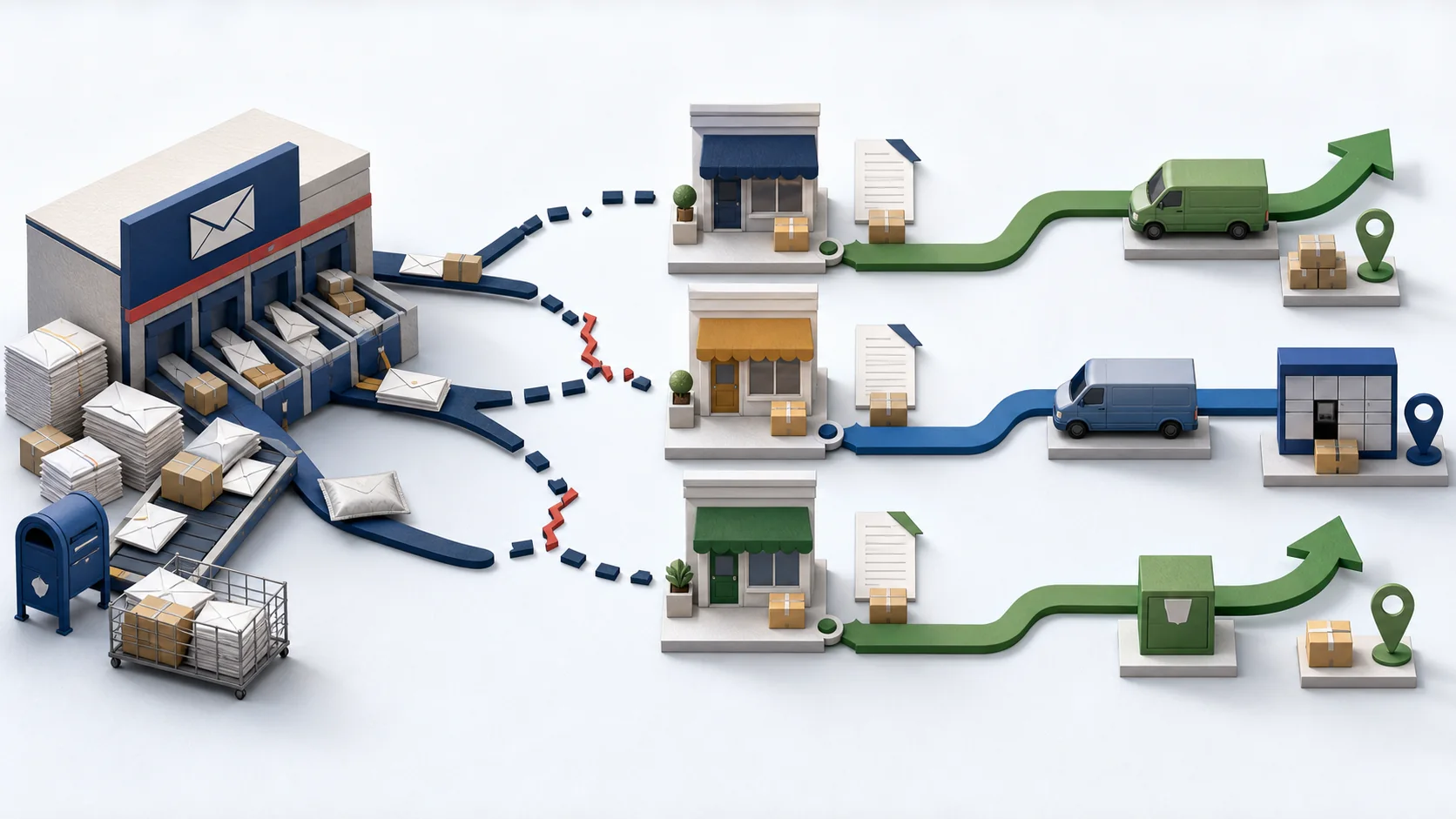
The instinct in coverage of a labor disruption is to treat the damage as temporary and reversible once the strike ends. CFIB's numbers say otherwise for a meaningful share of small businesses. During disruption, 71% of affected businesses encouraged customers to use digital options, 45% switched to private couriers, and 27% delayed mail. Most of that is workaround behavior, adopted under pressure and, for many, likely to revert once service resumes.
But 13% did not revert after the 2024 strike. They stopped using Canada Post permanently. That number, applied against Canada Post's overall small business customer base, is not a rounding error; it is a measurable, compounding loss that shows up a year later as market share decline. And 63% of the businesses still using Canada Post, roughly four in five small businesses per CFIB's data, say they are prepared to make the same permanent switch if the pattern repeats.
This is what a business dependent on a single logistics partner should actually be tracking: not just the direct cost of a disruption week, but what share of temporary workaround behavior converts into a permanent operational change. A 13% permanent-exit rate from one strike, repeated across two strikes in a year, compounds quickly. It is the mechanism behind a 38-point market share collapse that looks sudden in a headline but was built disruption by disruption.
Strike Cost vs. Permanent Exit Rate
The daily cost figure ends when the strike ends. The exit rate does not.
Strike-cost tracking (per-day dollar loss) resets to zero once service resumes. Permanent-exit tracking (the 13% who left after 2024, the 63% considering leaving now) compounds across disruption cycles, which is the actual driver behind a multi-year market share decline that a single strike's cost estimate cannot capture.

"Yo-yoing in and out of strike mandates is causing Canada's small businesses...to leave for good."
The Leadership Move
The structural choice for any organization dependent on a single logistics or service partner is whether to measure disruption only in daily cost, or to also track what share of workaround behavior becomes permanent.
- Ownership
Operations and logistics leadership at both Canada Post and its small business customers own this measurement gap. Canada Post needs to track permanent-exit rate as a leading indicator of market share, not wait for the annual report to show the cumulative result. Small businesses need to decide, deliberately, whether a strike-driven workaround becomes their new default rather than letting it happen by inertia.
- Tradeoff
Diversifying away from Canada Post ahead of the next disruption costs a small business setup time and potentially higher per-shipment rates through private couriers. The tradeoff against staying is a demonstrated, repeated exposure to $75 to $100 million in daily aggregate cost across the small business sector each time a strike occurs, with no guarantee the next one will not also produce a 13% permanent-exit rate.
- Human consequence
Small business owners experienced delayed cheques and invoices disrupting their own cash flow during two strikes in roughly a year. Their customers experienced delayed shipments. Canada Post's own workforce operates inside an organization whose customer base is measurably shrinking as a direct, documented consequence of the disruption pattern.
Next Move
If your business still depends primarily on Canada Post: Treat the 63% figure as a signal about your own switching readiness, not just other businesses'. Confirm whether your digital payment options and courier relationships are actually operational, not theoretical, before the next disruption forces the test.
If you already switched during a past disruption: Audit whether that switch was a deliberate, evaluated decision or an under-pressure workaround that never got formally reviewed. CFIB's data suggests a meaningful share of switches happen this way and are never revisited once the pressure lifts.
FAQ
How many small businesses say they would leave Canada Post permanently?
CFIB found that 63% of small businesses may permanently drop Canada Post if strikes resume. That follows an earlier disruption: 13% of small businesses already permanently stopped using Canada Post after the 2024 strike.
How much did the Canada Post strikes cost small businesses?
CFIB estimated the 2024 strike cost small businesses between $75 million and $100 million per day. During the September 2025 strike, small and medium-sized businesses lost an estimated $765 million in earnings after seventeen days, a rate of roughly $76.6 million per day.
Is Canada Post's market share decline caused by the strikes?
No, and that distinction matters. Canada Post's own reporting shows its parcel market share fell from 62% in 2019 to 24% in its most recent annual report, a decline that spans years and predates the 2024 and 2025 strikes. The strikes did not create that shift; they accelerated a switch to private couriers and digital alternatives that businesses were already making.
What are small businesses doing instead of waiting out the disruption?
CFIB found 71% of affected businesses encouraged customers to use digital options instead of mail, 45% switched to private couriers, and 27% simply delayed mail. These are not temporary strike workarounds for most; CFIB's data shows a portion of that switch becomes permanent, at a rate of 13% during the last cycle alone.
Sources & References
Original article archive
Original article published November 18, 2024: "Canada Post Strike: Design Better Customer Experience Now". Preserved here for provenance, historical context, and citation continuity.
The ongoing Canada Post strike has significantly disrupted mail and parcel delivery services across the country, causing widespread concern among businesses and consumers alike. This insight focuses on the strike, its implication to customer experience, and how can brands manage the crisis.
Canada Post Strike - What Is It?
Many Canadian businesses use Canada Post as their sole postal delivery service owing to good reliability, good customer service, and competitive pricing. Without an alternative, they are prone to the disruptions associated with strikes. The current labor dispute began on November 1, 2024, when the Canadian Union of Postal Workers (CUPW) initiated rotating strikes in major cities after negotiations with Canada Post failed to reach an agreement on key issues such as job security, working conditions, and wage parity.
As the strike entered its second week, the impact on mail delivery became more pronounced. Canada Post reported that parcel backlogs had reached over 1 million items, with delays extending to several weeks in some cases. The situation escalated on November 10, 2024, when CUPW announced a nationwide walkout, effectively halting all mail and parcel services across Canada. The strike's timing, coinciding with the start of Black Friday sales and the holiday shopping season, has amplified its effects on both consumers and businesses.
E-commerce companies, in particular, have been hit hard, with many reporting significant drops in sales and customer satisfaction. A survey conducted by the Canadian Federation of Independent Business (CFIB) found that:
- A strong majority (79%) of small businesses rely on Canada Post services to do business
- 75% of small firms said the strike will negatively impact their business, particularly with challenges to cash flow due to delayed invoices and cheques and higher cost delivery alternatives
Customer Experience Implications
The disruption in mail services has had a profound impact on customer experience across various industries:
- Retailers using flyers as a marketing tool have to find alternative ways such as digital flyer or SMS to communicate weekly sales.
- Healthcare providers have reported delays in delivering critical medical supplies and test results to patients.
- Financial institutions have struggled to send important documents and statements to their clients.
- Government services have been affected, with delays in processing and mailing tax refunds and other essential communications.

Crisis Management
For businesses across all sectors, clear and frequent communication with customers is crucial. Companies that have been transparent about the situation and the use of Canada Post and proactive in offering solutions will see higher customer satisfaction rates during this period.
To manage this crisis, companies have to adopt various strategies. E-commerce businesses need to be proactive with many implementing real-time updates on their websites to inform customers about potential delays. Some have partnered with local pickup carriers (like Uber) to offer alternative delivery options. Others will have to incur higher costs of shipping with Canada Post alternative couriers like DHL and UPS.

Some retail businesses have increased their in-store inventory to compensate for delayed shipments and have been encouraging customers to shop in person rather than online. For returns, some retailers are more flexible on return dates the package is already in the Canada Post system. Financial institutions have ramped up their digital communication efforts over the years, urging clients to switch to electronic statements and online banking services over paper statements.
Healthcare providers have been particularly challenged, given the critical nature of their shipments. Many have resorted to using specialized medical couriers for urgent deliveries, while also increasing their use of telemedicine services to reduce the need for physical document transfers.
Quick Tips on Managing the Canada Post Strike
There is no clear timeline on when the Canada Post strike will end. As implication looms, here is list of 15 quick tips for different companies to consider:
- Communication: Use alternative communication techniques such as chatbots, SMS, emails, website, or mobile application to engage customers, vendors, and other affected parties. Ensure these techniques are tested so that information is consistent across different channels.
- Timing: Consistently communicate with customers, vendors, and other affected parties on the delay impacts, offer solutions, and reset expectations. This will alleviate some anxiety caused by the disruptive event.
- Policies: Adapt and improve related customer experience policies to ensure affected parties are not left out to their own devices.
- Diversify shipping options: Don't rely solely on Canada Post. Establish relationships with multiple courier services to ensure continuity of deliveries, as required.
- Feature changes: Until the strike ends, assesses shipping features across all channels and ensures that Canada Post is not a shipping or return option available for customers.
- Offer local/regional pickup options: Where possible, provide customers with the option to pick up or return their orders from a physical location.
- Prioritize critical shipments: Identify which deliveries are most time-sensitive and use premium shipping services for these items.
- Optimize packaging: With alternative shipping methods potentially being more expensive, review your packaging to ensure it's as compact and lightweight as possible without compromising product safety.
- Review and adjust inventory management: Consider increasing stock levels to buffer against potential supply chain disruptions.
- Customer support: Businesses should evaluate the level of customer support required and have an expansion plan in place to handle the increased traffic from the Canada Post disruption.
- Offer incentives for patience: Consider providing discounts or future credits to customers who are willing to wait longer for their deliveries.
- Stay informed: Keep abreast of the latest developments in the strike negotiations and be prepared to adjust your strategies accordingly.
- Create separate space: For brands facing significant impact on the Canada Post strike, create a separate webpage highlighting the impact, solutions available, and next steps. An all-inclusive space will reduce customer frustration searching for information.
- Annual testing: Nothing should be left to chance. Given shipping plays an important component for many businesses, they should be ready to. manage disruption on day one. This is accomplished by conducting annual testing on policies and procedures similar to ones completed for disaster recovery and business continuity.
- Return to normal plan: When the strike is over, ensure there is a plan in place to manage shipment processing. As it will take some time for Canada Post service to fully return to normal, it is important to stay resilient, transparent, and communicative with all affected parties.
Bonus tip:
Training/education and contextual engagement: When a company is under crisis, it is important for them to train employees and management on the latest policies and procedures, provide support, and ensure metrics are available for quick actions. Communication channels should be updated to ensure everyone accesses the same messaging and next steps. As anxiety goes up, empathy should be shown more widely.
All affected companies should regularly monitor and review the Canada Post website for updates.
Transform For Better
The Canada Post strike, while disruptive, presents an opportunity for businesses to transform and improve their operations. This crisis has highlighted the importance of adaptability and resilience in supply chain management. Companies that emerge stronger will be those that use this experience to build more robust and flexible logistics systems. One key area for transformation is the acceleration of digital initiatives. Businesses should invest in enhancing their online presence and e-commerce capabilities. This includes improving website functionality, implementing more sophisticated inventory management systems, and developing user-friendly mobile applications.
Another crucial aspect is the development of a more diversified and localized supply chain. Companies should explore partnerships with regional suppliers and logistics providers to reduce dependency on a single national carrier. This approach not only mitigates risks associated with future disruptions but can also lead to more efficient and sustainable delivery models. Customer service is another area ripe for transformation. The strike has underscored the importance of clear, timely, and empathetic communication.
Businesses should invest in training their customer service teams to handle crisis situations effectively. Additionally, implementing AI-powered chatbots and self-service portals can help manage increased customer inquiries during disruptions.
Finally, this situation presents an opportunity for businesses to reevaluate their overall logistics strategy. This might involve exploring innovative solutions such as drone deliveries for urban areas or partnering with shared economy platforms for last-mile delivery. By embracing these transformations, businesses can not only weather the current crisis but also position themselves for long-term success in an increasingly unpredictable business environment.
The Canada Post strike serves as a wake-up call for businesses to build more resilient, flexible, and customer-centric operations. Those who view this challenge as an opportunity for transformation will likely find themselves better equipped to handle future disruptions and meet evolving customer expectations.
How Can We Help?
Transformidy is available to assist in helping you understand trust and assess how the Canada Post strike affect your business.
Contact us or set up a 30-minute complimentary consultation for more information on our services, insights, or showcases. We look forward to hearing from you.
FAQ
How many small businesses say they would leave Canada Post permanently?
CFIB found that 63% of small businesses may permanently drop Canada Post if strikes resume. That follows an earlier disruption: 13% of small businesses already permanently stopped using Canada Post after the 2024 strike.
How much did the Canada Post strikes cost small businesses?
CFIB estimated the 2024 strike cost small businesses between $75 million and $100 million per day. During the September 2025 strike, small and medium-sized businesses lost an estimated $765 million in earnings after seventeen days, a rate of roughly $76.6 million per day.
Is Canada Post's market share decline caused by the strikes?
No, and that distinction matters. Canada Post's own reporting shows its parcel market share fell from 62% in 2019 to 24% in its most recent annual report, a decline that spans years and predates the 2024 and 2025 strikes. The strikes did not create that shift; they accelerated a switch to private couriers and digital alternatives that businesses were already making.
What are small businesses doing instead of waiting out the disruption?
CFIB found 71% of affected businesses encouraged customers to use digital options instead of mail, 45% switched to private couriers, and 27% simply delayed mail. These are not temporary strike workarounds for most; CFIB's data shows a portion of that switch becomes permanent, at a rate of 13% during the last cycle alone.
Related intelligence
Article
Quebec's Language Fines Are Not Per Violation. They're Per Day.
Quebec's language regulator received 6,884 complaints in a single year, mostly from consumers, not inspectors. As of June 2025, the francization threshold dropped from 50 employees to 25, pulling far more businesses into a fine structure that escalates per day, not per violation.
Article
Record Ad Prices, Seven-Year-Low Brand Recall
Super Bowl ads hit a record $10 million for 30 seconds in 2026. In the same broadcast, 22% of viewers could not remember the brand after watching, a seven-year low. Most ads tested at only 2.7 out of 5.9 possible stars. The price and the effectiveness moved in opposite directions.
Article
Customers Now Expect AI to Show Its Work
Demand for AI transparency in customer interactions rose 63% year over year. 95% of consumers now expect to understand the 'why' behind an automated decision. The reasoning-model era normalized showing work. Customer expectations followed it home.