
Article
The Report That Audited Robots and Hallucinated Its Own Citations
A firm whose entire service is verification can still fail to verify its own output, if nobody explicitly owns checking AI-generated content before a client sees it. The irony sharpens considerably when the report in question is reviewing a government's own automated penalty system.
- Published
- September 3, 2026
- Updated
- August 19, 2026
- Reading time
- 9 min

The Global Signal
Deloitte Australia delivered a report to the Department of Employment and Workplace Relations, published on the department's website in July 2025, reviewing the government's Targeted Compliance Framework, the automated system used to assess penalties against welfare recipients. The contract was valued at roughly AU$440,000 (about US$290,000). A University of Sydney researcher, Chris Rudge, found the report cited a non-existent book he said was falsely attributed to Lisa Burton Crawford, a real professor of public and constitutional law, and that the report also contained a quote misattributed to a federal court judgment. Deloitte issued a revised version of the report on September 26, 2025, removing the fabricated citations and quote, and agreed to refund the government's final payment installment on the contract.
Contract value for the government report later found to contain fabricated citations
Directly confirmed via Fortune's reporting (approximately US$290,000); Deloitte agreed to refund only the final payment installment, not the full contract value.
The irony sharpens considerably when the report in question is reviewing a government's own automated penalty system.
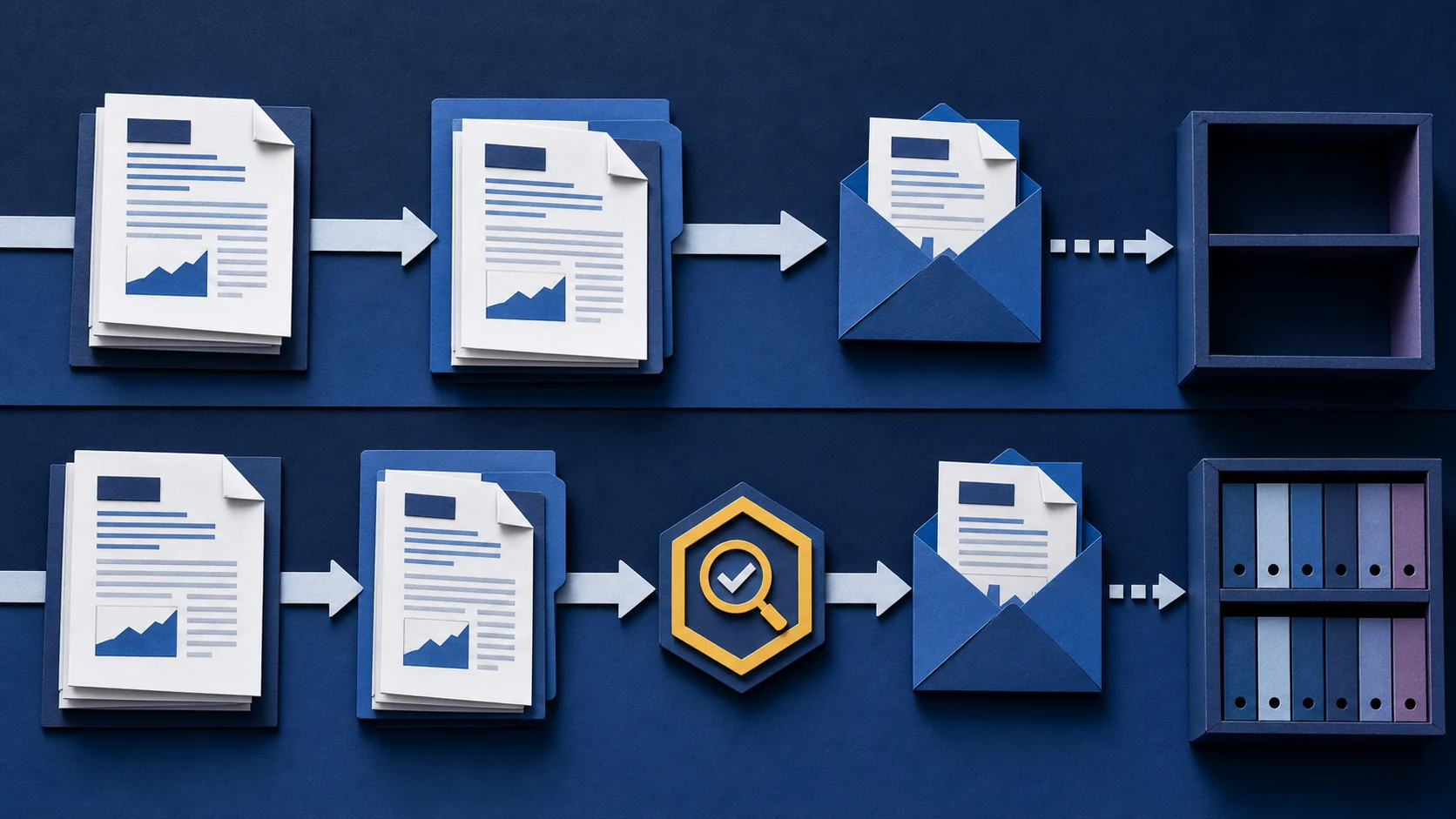
What changes when verification is a named, mandatory step
A firm's general reputation for rigor is not evidence a specific document was independently checked before delivery.
Assigning independent citation verification to a named person, distinct from the drafter, for every AI-assisted deliverable closes the gap this case exposed.
Why the Visible Metric Misleads
A firm's reputation for rigor, its brand, its client roster, its billing rate, is not evidence that a specific deliverable was independently fact-checked before delivery. Reputation describes the organization's general capability; it says nothing about whether a specific verification step was actually applied to a specific document. The more revealing question for any AI-assisted deliverable is whether a named person, distinct from whoever drafted the content, is required to independently verify every citation and quote before the document reaches a client, and whether that requirement was followed on this specific document, not whether the firm is generally known for careful work.
The Leadership Move
The right move is not banning generative AI tools from professional deliverables, which can genuinely speed up drafting work. It is requiring a named, independent verification step for every citation, quote, and factual claim an AI tool contributes to a client-facing document, applied before delivery, not discovered afterward by the client or a third party.
- Ownership
Whoever drafts a report using AI assistance owns producing a complete first draft efficiently. A separate, named reviewer needs to own independently verifying every citation and quote against a real source before the document is considered final. When the same person or team owns both drafting and verification, the verification step tends to inherit the drafter's own confidence rather than functioning as a genuine independent check.
- Tradeoff
A mandatory, independent citation-verification step slows down delivery and adds a real cost to every AI-assisted deliverable, a cost that is easy to skip when a deadline is close and the drafted content reads confidently. The alternative, a fabricated citation and a fabricated court quote reaching a government department's public website, cost Deloitte a public correction, a partial refund, and a considerably more visible reputational exposure than the verification step would have.
- Human consequence
The report's actual subject, an automated system used to assess penalties against welfare recipients, makes this case sharper than an ordinary citation error: the same organizational failure, trusting an unverified AI output because it looked confident, is exactly the failure mode the report itself was meant to help the government guard against in its own automated systems.
Implication for Operators
Any organization delivering AI-assisted work product to a client should assume that using a capable tool and having a generally strong verification culture are not the same as having assigned independent verification as a specific, mandatory, named step for this specific document. The practical shift is requiring that step explicitly for every AI-assisted deliverable, rather than trusting that a firm's general rigor will catch what a specific process step was never assigned to catch.
Deloitte's own business is built on the premise that its reports can be trusted more than an organization's own internal review. This case shows that premise depends entirely on a specific verification step being assigned to a specific person for a specific document, and that a firm's general reputation for rigor is not a substitute for that assignment ever having been made.
An AI tool inventing a citation is the surface detail. A verification firm never assigning that check to a specific person for this specific document, in a report about the exact kind of unverified automated decision it was supposed to be reviewing, is the actual failure.
Before automating a workflow or routing rule, how explicitly does your organization decide what the system should optimize for and who owns exceptions?
FAQ
How was the error in Deloitte's report discovered?
A University of Sydney researcher, Chris Rudge, identified that the report cited a book that does not exist, falsely attributed to a real academic, Lisa Burton Crawford, and separately found a quote in the report misattributed to a federal court judgment.
Did Deloitte fully refund the contract?
Deloitte agreed to refund the government's final payment installment on the roughly AU$440,000 (about US$290,000) contract, a partial refund rather than the full contract value.
Was this report reviewing an AI system, or did it use AI to produce itself?
Both. The report reviewed the Australian government's Targeted Compliance Framework, an automated system used to assess welfare-recipient penalties, and the report itself was found to contain AI-generated content that had not been independently verified before delivery.
Did Deloitte acknowledge using AI to produce the report?
The revised version of the report, issued September 26, 2025, removed the fabricated citations and quote; broader reporting on the case describes Deloitte disclosing AI use in the revision, though this draft does not independently confirm the exact wording of that disclosure.
How can a firm prevent this without banning AI drafting tools?
By assigning independent citation and quote verification as a named, mandatory step, performed by someone other than the drafter, applied before delivery to every AI-assisted deliverable, not as a general expectation but as a specific checked box.
Related intelligence
Article
The Algorithm and the Randomized Trial
Two education systems built algorithms to help make decisions about individual students at scale. One imposed its algorithm nationally, on results day, with no pilot and no override. The other tested its tool for years, on a smaller population, before trusting it broadly, and built it to route stude
Article
The Playbook Before the Rollout
Two governments built automated systems that made consequential decisions about their citizens. One never wrote down, before deployment, what pre-launch testing an AI system had to pass. The other built a public assurance playbook years earlier, and has kept updating that playbook as the technology
Article
The Algorithm That Toppled a Cabinet
A warning can exist, in an organization's own files, written by exactly the person whose job is to catch this kind of problem, and still change nothing at all. Writing a memo and routing it to someone with the authority to act on it are two separate acts, and a government can be entirely honest that