
Article
Nintendo Is Forecasting Its Own Sales to Fall, on Purpose
Nintendo shipped 19.86 million Switch 2 units in its first year, beating its own guidance, and is now forecasting a drop to 16.5 million in year two. Most companies would call that a decline. Nintendo is calling it a plan, and the difference tells you everything about how they read their own launch.
- Published
- January 17, 2025
- Updated
- June 18, 2026
- Reading time
- 8 min
2026 updated analysis
What changed since the original article
This page keeps the original Transformidy article as the canonical record and leads with the current interpretation, source notes, and Revenue Unknown framing.
The Launch-Year Record
The Nintendo Switch 2 launched on June 5, 2025, and sold 3.5 million units worldwide in its first four days, a Nintendo record. By the end of fiscal year 2026, which closed March 31, 2026, Nintendo had shipped 19.86 million units globally, exceeding its own guidance of approximately 19 million. That combination, a record opening and a full year beating internal guidance, is about as clean a launch result as a hardware product can produce.
Software attach reinforces that the units were not simply purchased and shelved. Software reached 48.71 million units in the same period, an attach rate of 2.45 games per console, with Mario Kart World alone selling 14.70 million units, roughly a 74% attach rate against the installed base. Three in four Switch 2 owners bought that one title, a strong indicator of active engagement rather than passive hardware accumulation.
Switch 2 units shipped globally in the first fiscal year, beating the company's own guidance
Nintendo's own FY2027 forecast projects 16.5 million units, a stated, deliberate decline from the launch-year figure.
The Forecast That Names Its Own Slowdown
Most companies coming off a record launch year do one of two things with the following year's guidance: they either project continued growth, setting themselves up for a miss when the natural post-launch normalization arrives, or they issue vague, hedged language that avoids committing to a specific number at all. Nintendo did neither. It shipped a specific, lower number, 16.5 million against 19.86 million, and let its own reporting describe that gap as expected demand normalization rather than a risk factor to be managed around.
This matters because launch-year sales figures are structurally inflated by a wave of demand that cannot repeat: customers who had been waiting for the product before it even existed, early adopters willing to pay any friction cost to get it first, and a marketing and media cycle concentrated entirely on the launch window. None of that demand carries forward automatically into year two at the same intensity, and a company that fails to account for it internally risks either overproducing inventory against an unrealistic growth assumption or being caught flat-footed when the natural decline arrives and gets read externally as a problem.
By stating the lower number explicitly and in advance, Nintendo converts what could be read as a warning sign, sales declining year over year, into evidence of forecasting discipline. The number is the same regardless of framing. What changes is whether the market interprets it as Nintendo understanding its own business or Nintendo losing momentum, and that interpretation is being shaped now, before the fiscal year 2027 results exist to speak for themselves.
Unexplained Decline vs. Named, Forecasted Normalization
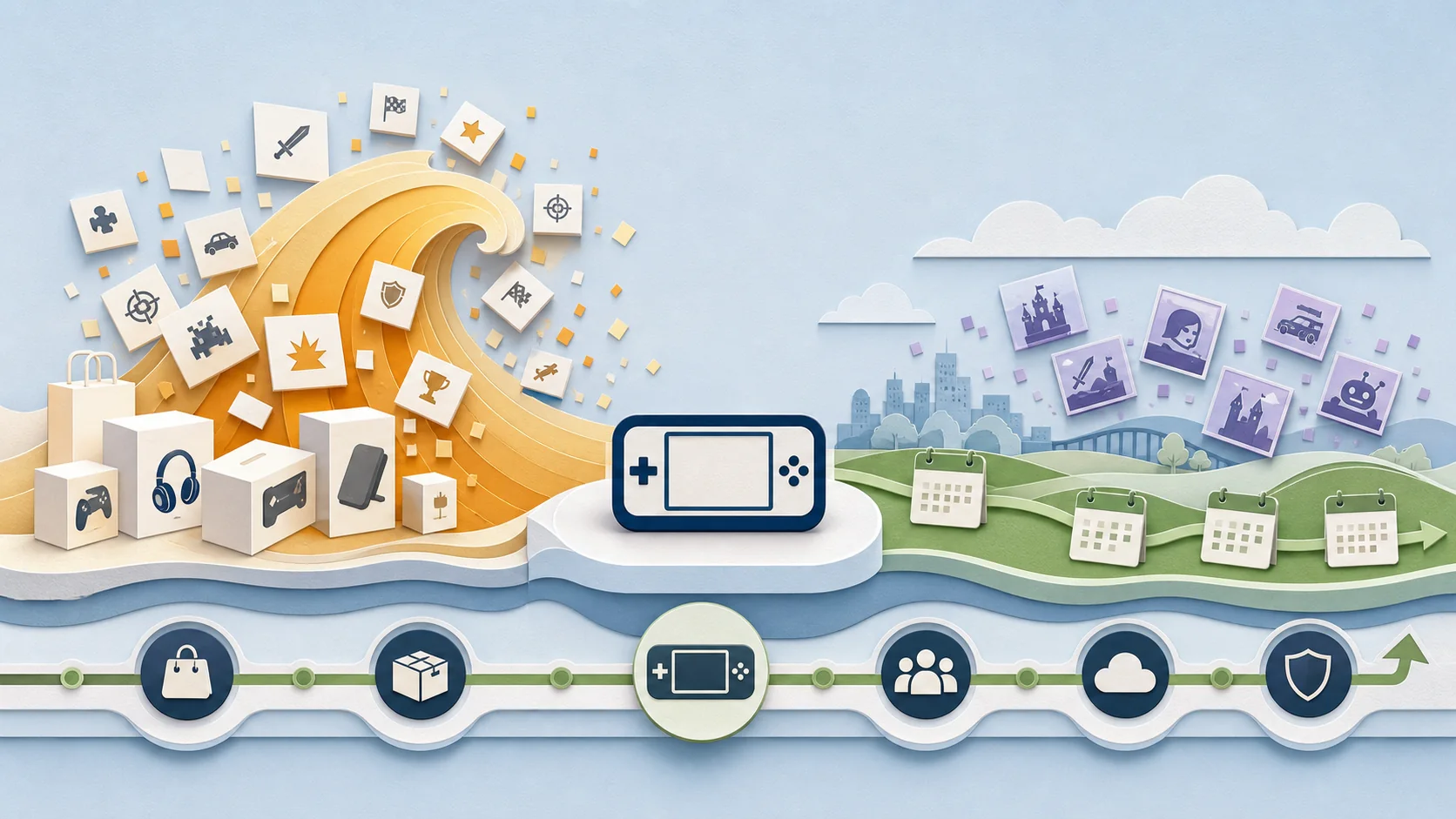
The same lower number, communicated two different ways, produces two different market reactions.
Unexplained decline: year-two numbers come in lower than year one with no advance signal, read as a warning sign regardless of the underlying cause. Named normalization: the company states the expected decline in advance and explains it as launch-year demand cooling, read as evidence of forecasting discipline.
A company that forecasts its own slowdown is not admitting weakness. It is proving it understood its own launch before anyone else had to explain it back to them.
The Leadership Move
The structural choice after any strong product launch is whether to name the expected post-launch normalization explicitly in forward guidance, or to let optimistic momentum carry the next forecast until reality forces a correction.
- Ownership
Finance and product leadership jointly own launch-year demand decomposition, separating pent-up demand from durable ongoing demand before the next forecast is set. When this analysis does not happen deliberately, the next forecast defaults to extrapolating launch-year momentum forward, which is the setup for a miss.
- Tradeoff
Stating a lower year-two forecast risks a short-term perception cost, since a declining number reads negatively to anyone who has not read the explanation behind it. The alternative, projecting continued growth or staying vague, avoids that immediate discomfort while setting up a larger credibility cost when the real numbers land below an unrealistic expectation the company itself set.
- Human consequence
Retail partners, suppliers, and internal teams planning around a launch product's second year make real operational decisions, inventory levels, staffing, production commitments, based on the guidance they are given. A named, explained forecast lets them plan accurately; an inflated or vague one sets them up to over-commit against demand that was never going to materialize.
Next Move
If you are approaching the one-year mark after a strong product launch: Decompose your own launch-year numbers into pent-up demand versus durable ongoing demand before setting next year's guidance, and consider stating the expected normalization explicitly rather than letting the market discover it unexplained.
If you are evaluating a company's post-launch forecast, as an investor, partner, or competitor: Distinguish between a company naming its own expected slowdown in advance, as Nintendo did, and a company whose numbers simply come in lower with no prior explanation. The first is a credibility signal. The second is a genuine open question.
FAQ
How well did the Nintendo Switch 2 actually sell in its first year?
Nintendo shipped 19.86 million Switch 2 units globally in fiscal year 2026 (April 2025 through March 2026), exceeding its own guidance of roughly 19 million. The console sold 3.5 million units in its first four days after launching June 5, 2025, making it the fastest-selling console in Nintendo's history.
Why is Nintendo forecasting lower sales for the next fiscal year?
Nintendo's own fiscal year 2027 forecast projects 16.5 million Switch 2 units, down from 19.86 million, which the company itself describes as a normalization after the strong launch year rather than a sign of trouble. A launch year concentrates demand from customers who were waiting for the console before it even released, a wave that does not repeat in year two by definition.
How strong was software attach, and what does it say about the install base?
Nintendo sold 48.71 million Switch 2 software units in the same period, an attach rate of 2.45 games per console. Mario Kart World alone reached 14.70 million units, a roughly 74% attach rate against the console's own installed base, meaning close to three in four Switch 2 owners bought that specific title.
Should other companies read a self-forecast decline as automatically negative?
Not on its own. A forecast decline paired with clear reasoning, in Nintendo's case an explicit acknowledgment of launch-year demand normalization, is meaningfully different from a decline that surprises a company or gets explained away after the fact. The distinction is whether the company named the pattern in advance or is reacting to it after the numbers already moved.
Sources & References
Original article archive
Original article published January 17, 2025: "Nintendo Switch 2: Exciting New Gaming and Experiences in 2025". Preserved here for provenance, historical context, and citation continuity.
In a world where gaming consoles constantly push the boundaries of technology, Nintendo could once again proven that true innovation lies in refinement and accessibility. The Nintendo Switch 2, set to launch in 2025, isn't just another leap forward in graphics or processing power – it's a carefully crafted evolution of a beloved gaming experience. As the lines between casual and hardcore gamers continue to blur, Nintendo's latest offering promises to bridge that gap with a blend of familiar comfort and exciting new possibilities. Get ready to discover how the Nintendo Switch 2 is poised to redefine the gaming landscape, capture the hearts of players across generations, and build new experiences.
Introduction - The Video Game Industry Landscape
The video game industry has come a long way since the release of the first home console, the Magnavox Odyssey, in 1972. Over the past five decades, we've witnessed the rise and fall of numerous gaming giants, with today's market dominated by three key players: Nintendo, Sony, and Microsoft. As of 2025, the current generation of consoles has seen impressive sales figures, with the PlayStation 5 reaching 65.6 million units sold, the Xbox Series X/S at 28.3 million, and the Nintendo Switch leading the pack with an astounding 146.04 million units as at September 2024.
Nintendo Switch Worldwide sales thru 2024
0Estimated Number of Units
Despite these impressive numbers, the industry has faced challenges in recent years. The global gaming market experienced a slight decline in 2023, dropping 3.5% in revenue. However, analysts predict a rebound in 2025, driven by new hardware releases and major game launches. This resurgence is expected to push the industry's revenue to an estimated US$26.7 billion by 2029, up from US$16.4 billion in 2018.
Nintendo Switch Legacy
Nintendo has been a cornerstone of the gaming industry since the release of the Nintendo Entertainment System (NES) in 1985. Over the years, the company has consistently innovated, introducing beloved franchises like Super Mario Bros., Zelda, and Pokémon, while pushing the boundaries of gaming hardware via accessibility and controls. The Nintendo Switch, launched in 2017, marked a significant milestone for the company, blending handheld and home console gaming in a single device. This hybrid approach resonated strongly with consumers, leading to record-breaking sales and a revitalization of Nintendo's position in the market over the past 7 years.
The Switch's success can be attributed to its versatility, strong first-party game lineup, and appeal to a wide range of demographics without breaking the bank with break neck technologies. It has become the third best-selling console of all time, surpassing the Game Boy and PlayStation 4. This legacy sets much higher expectations for its successor, the Nintendo Switch 2.
Nintendo Switch 2: A Closer Look
The newly announced Nintendo Switch 2 builds upon the success of its predecessor while introducing key improvements. Based on the reveal trailer and industry leaks, we can expect the following features:
- Larger screen: Up to an 8-inch LCD display, up from the original Switch's 6.2-inch screen.
- Enhanced performance: Powered by a custom Nvidia chip with 8GB LPDDR5 RAM and 256GB UFS 3.1 storage.
- Improved graphics: Support for DLSS 2 and FSR 3 upscaling technologies, potentially allowing for 4K output when docked.
- Redesigned Joy-Con controllers: Larger, with additional buttons and potentially using hall effect analog sticks to prevent drift issues.
- Backward compatibility: Support for original Switch games, both physical and digital.
While Nintendo has not officially announced pricing, industry analysts speculate the new model will go up in price from US$300 before discounts for the standard model to an estimated US$350 to $400 with the updated specs. This positioning would keep the Switch 2 competitive with the standard versions the PlayStation 5 and Microsoft Xbox current generation consoles.
Customer Experience Implications and Opportunities
Customer experience plays an important role in keeping Nintendo Switch players happy over the past seven years. Partnerships, exclusive platform games, and Lego integration are some of the concepts Nintendo deployed to keep the console fresh in the marketplace and in gamers' psyche. The launch of the Nintendo Switch 2 presents a new generation of opportunities to enhance customer experience across various touch points:
- Player Engagement: The improved hardware capabilities of the Nintendo Switch 2 will allow for more immersive gaming experiences, potentially increasing play time and engagement. Nintendo can leverage this by developing games that take full advantage of the new hardware while maintaining the accessibility that made the original Switch so popular with both casual and hardcore gamers.
- Audience Expansion: While the Switch already appeals to a broader demographic than its competitors, the Nintendo Switch 2's enhanced capabilities (potentially through the joy-cons and new accessories) could attract a bigger audience in the fold.
- Marketing Strategy: Nintendo's marketing has traditionally focused on the joy of gaming and social experiences. For the Nintendo Switch 2, they could emphasize the improved graphics and performance while maintaining their family-friendly image. Utilizing influencer partnerships and social media campaigns can help reach both existing fans and new audiences across different omni-channels.
- Game Development and Availability: The backward compatibility feature ensures a robust game library at launch (12,500 games worldwide and counting as at December 2024). However, Nintendo should prioritize developing and securing exclusive titles that showcase the Nintendo Switch 2's full capabilities. Partnerships with third-party developers will also expand the game lineup.
- Customer Loyalty: Nintendo can leverage its existing fan base by offering special editions, loyalty rewards, and early access programs for Nintendo Switch 2 pre-orders. This approach can help maintain customer loyalty during the transition to the new console. Additionally, its loyalty program "My Nintendo" could also be enhanced with innovation such as a digital badge system.
- Physical and Online Interactions: With the ongoing shift towards digital gaming, Nintendo could focus on improving its online infrastructure. This includes enhancing the Nintendo eShop experience, offering cloud gaming services, and improving online multiplayer functionality.
- Customer Service: As with any new hardware launch, robust customer support will be essential. Nintendo should prepare for increased support requests and consider implementing AI-powered chatbots and community forums to address common issues quickly.

A Look Into Revenue Generation and Success
For the Nintendo Switch 2 to be considered a success, it will need to meet or exceed the performance of its predecessor. Industry analysts are projecting sales of 15-17 million Nintendo Switch 2 units in 2025 depending on its availability and release dates. There is a potential to reach 80 million units by 2028.
To achieve these targets, Nintendo should focus on:
- Strong launch lineup: Securing system-selling exclusive titles, potentially including a new Mario Kart game as teased in the reveal trailer. The Nintendo Switch
- Competitive pricing: Maintaining a price point that offers value while reflecting the improved hardware capabilities.
- Effective marketing: Highlighting the system's unique features and broad appeal to various demographics.
- Continuous software support: Ensuring a steady stream of high-quality first-party and third-party games throughout the console's lifecycle.
- Online service improvements: Enhancing Nintendo Switch Online to compete with Sony and Microsoft's offerings.

Challenges from Marketplace Changes and Competition
Despite its strong market position, Nintendo faces several challenges with the Nintendo Switch 2:
- Increased competition: Both Sony and Microsoft released or will release updated consoles from 2024-2028. This could potentially overshadow the Switch 2's technical capabilities and gamer attention.
- Mobile gaming growth: The continued rise of mobile gaming threatens to capture casual gamers' focus and spending. This is a big threat as console games prices continue to expand with the average game now costs on average US$69.99 in the United States (2022).
- Economic factors: Global economic uncertainties could impact consumer spending on gaming hardware and software in the next 12-18 months.
- Supply chain issues: Ongoing chip shortages and manufacturing constraints could limit initial availability and might slow adoption on Day 1.
Partnerships and Expansion Opportunities
Nintendo has successfully leveraged partnerships to expand its brand beyond gaming. For the Nintendo Switch 2, they could continue to expand various collaborations and add new avenues of partners in different spaces.
- Theme Parks: Building on the success of Super Nintendo World at Universal Studios, Nintendo could explore additional locations and attractions featuring Nintendo Switch 2 game integration (e.g., gamers can gain achievements by playing specific games and activate new components at the theme parks).
- Travel and Entertainment: Partnerships travel and entertainment companies such as airlines, hotels, cruise lines and film studios to engage travellers on the new Switch 2 gaming experiences. Super Mario Bros. Movie 2 being released in 2026 could be directly integrated with the console.
- Fast Food: Fast food chain collaborations has always been a major marketing push for brands to reach out to a broad range of audiences. With well timed themed meals and toys similar to past McDonald's Happy Meal promotions, the Nintendo Switch 2 could gain more exposures.
- LEGO: LEGO started its partnership with Nintendo in 2020 with a Super Mario line over the past five years along with iconic sets featuring Super Nintendo. The two companies can continue the partnership with new elements featured in games.
- Fashion and Lifestyle: Collaborations with clothing brands and designers to create Nintendo-themed apparel and accessories. Amazon has a partnership with Nintendo to sell merchandise such as memory cards to clothes.
- Healthcare: Similar to LEGO, there is a potential for Nintendo to collaborate with healthcare companies as part of physical and cognitive therapy processes.
The Future of Gaming and Customer Experience
The Nintendo Switch 2 will lead into the next generation of gaming. With that said, there are several trends are shaping the future of gaming and customer experience including:
- Augmented Reality (AR)/Virtual Reality: Integration of AR/VR features in games and the console itself, blending virtual and real-world experiences. Unlike Sony, Nintendo has not entered into the AR or VR market over the years. However, it uses unique play features (e.g., Wii Sports).
- Immersive Technologies: Advancements in haptic feedback, 3D audio, and potentially holographic displays to create more engaging gaming environments.
- Cloud Gaming: Expansion of cloud-based gaming services, reducing the need for powerful local hardware.
- Cross-Platform Play: Increased focus on seamless gaming experiences across multiple devices and platforms.
- Personalization: Utilizing AI and machine learning to tailor gaming experiences to individual preferences.
- Social Integration: Enhanced social features that allow for more meaningful connections between players.
Key Takeaways from this Transformidy Insight - Nintendo Switch 2
- The Nintendo Switch 2 retains the hybrid design of its predecessor, featuring a larger 8.4-inch OLED screen and improved Joy-Con controllers with magnetic attachments. Backward compatibility with original Nintendo Switch games is confirmed, ensuring a smooth transition for existing users. A new Mario Kart game is teased, potentially launching alongside the console and becoming its best-selling title.The Nintendo Switch 2 is expected to support 4K output when docked and feature improved graphics capabilities, including DLSS and ray tracing support.
- Analyst firm DFC Intelligence predicts strong first-year sales of 15-17 million units, with projections of over 80 million units sold by 2028.
- The console's reveal trailer showcased a more mature and straightforward approach compared to previous Nintendo launches, focusing on functionality over gimmicks.
- Nintendo is hosting "Nintendo Switch 2 Experience" events worldwide, allowing fans to try the console before its official launch.
- There are new customer experience possibilities and opportunities with the release of Nintendo Switch 2.
Transform for Better - A Call For Action
As the gaming industry evolves, companies must adapt their customer experience strategies to meet changing expectations. Transformidy is uniquely positioned to help gaming companies to navigate these challenges and opportunities.
By leveraging data-driven insights, advanced analytics, and innovative CX solutions, Transformidy can assist in:
- Strategizing online services and digital storefronts to enhance user engagement and satisfaction.
- Assessing and creating seamless omni-channel experiences that bridge the gap between physical and digital interactions.
- Assessing and recommending customer support systems to improve response times and issue resolution.
- Assessing and improving loyalty programs that incentivize long-term engagement, brand advocacy and sales.
The launch of the Nintendo Switch 2 represents a pivotal moment in the gaming industry. By partnering with Transformidy, Nintendo and other gaming companies can ensure they're not just keeping pace with customer expectations but setting new standards for excellence in gaming experiences. Together, we can transform the future of gaming, one player at a time.
Next Steps
Transformidy is available to help you understand your brand’s value proposition and maximize your customer experience strategy for business growth, engagement, and satisfaction.
Contact us or set up a 30-minute complimentary consultation for more information on our services, insights, or showcases. We look forward to hearing from you.
FAQ
How well did the Nintendo Switch 2 actually sell in its first year?
Nintendo shipped 19.86 million Switch 2 units globally in fiscal year 2026 (April 2025 through March 2026), exceeding its own guidance of roughly 19 million. The console sold 3.5 million units in its first four days after launching June 5, 2025, making it the fastest-selling console in Nintendo's history.
Why is Nintendo forecasting lower sales for the next fiscal year?
Nintendo's own fiscal year 2027 forecast projects 16.5 million Switch 2 units, down from 19.86 million, which the company itself describes as a normalization after the strong launch year rather than a sign of trouble. A launch year concentrates demand from customers who were waiting for the console before it even released, a wave that does not repeat in year two by definition.
How strong was software attach, and what does it say about the install base?
Nintendo sold 48.71 million Switch 2 software units in the same period, an attach rate of 2.45 games per console. Mario Kart World alone reached 14.70 million units, a roughly 74% attach rate against the console's own installed base, meaning close to three in four Switch 2 owners bought that specific title.
Should other companies read a self-forecast decline as automatically negative?
Not on its own. A forecast decline paired with clear reasoning, in Nintendo's case an explicit acknowledgment of launch-year demand normalization, is meaningfully different from a decline that surprises a company or gets explained away after the fact. The distinction is whether the company named the pattern in advance or is reacting to it after the numbers already moved.
Related intelligence
Article
Nintendo's Own Games Are Not What Grew 76% Last Year
Third-party software sales on Switch and Switch 2 hit $2.3 billion in 2025, up 76% from the year before. Warner Bros., not Nintendo, was the top publisher. The console everyone associates with Mario is now, by dollar volume, being carried by games Nintendo did not make.
Article
One Fountain Stunt Became a 24-Race Season-Long Program
Disney's Fuel the Magic campaign with F1 started as one Mickey Mouse appearance at the Fountains of Bellagio. A year later it is a season-long program across all 24 races, WEBTOON comics, and multiple retail lines. That expansion rate is the actual story, not the fountain stunt.
Article
Loyalty Programs as Business Model: Strategy Over Retention Tactics
Loyalty programs matured from retention tactics to business model drivers. Industry data shows 90% of programs report positive ROI, but the returns are concentrated among members who actually redeem and engage—not the full enrolled base.