Customers feel friction before dashboards explain it.

Revenue Friction is the cost created when customer experience, employee enablement, partner behavior, technology, policy, and recovery do not operate as one system.

Customers experience the seams before leaders see the pattern. Revenue Friction is the financial signal of organizational fragmentation.

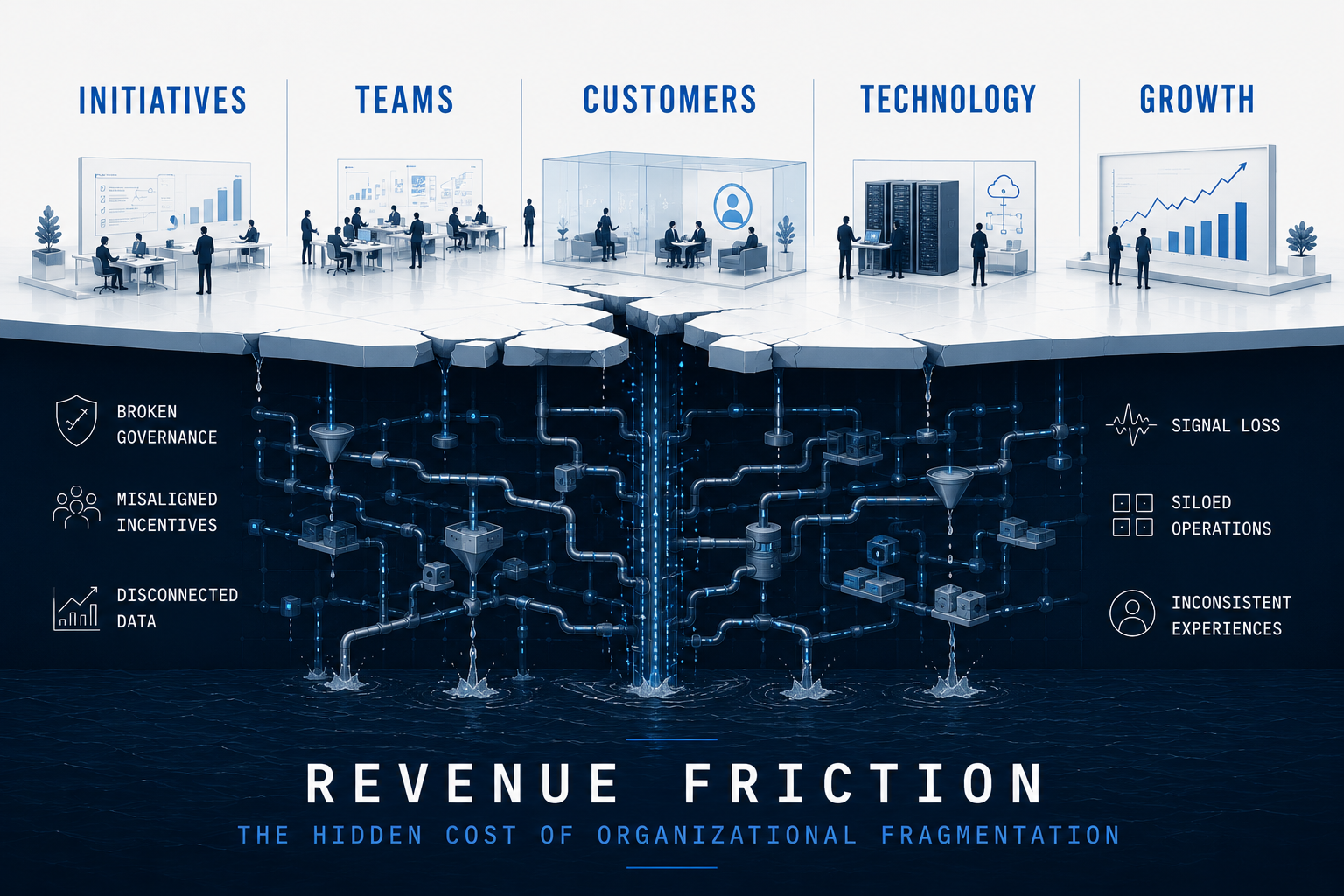
The diagram appears after the narrative because the map should confirm the pattern, not carry the opening alone.

Revenue leakage becomes visible when symptoms cluster.

Revenue leaks through fragmented experiences: churn risk, delay, complaints, lost conversion, repeat contacts, and recovery effort all point back to disconnected systems.

Approved Revenue Friction diagram showing visible organizational activity above hidden operating leaks including broken governance, misaligned incentives, disconnected data, signal loss, siloed operations, and inconsistent experiences.
Approved Revenue Friction diagram: visible activity above the hidden operating leakage caused by fragmentation.
Revenue Friction is the financial signal of organizational incoherence.
Transformidy Revenue Friction thesis
Customer effortRevenue leakage

ED-009

Experience Diagnostic

Revenue Friction Has Five Components

The financial signal of infrastructure gaps

Revenue Friction is the economic signal of fragmentation, distributed across five components: sales cycle elongation, support cost inflation, NRR degradation, customer acquisition cost inflation, and recovery cost inflation. When BEUP gaps exist, these signals often appear together.


Revenue Friction

Revenue Friction is the commercial cost of organizational incoherence.

Revenue Friction is the economic signal of fragmentation. It appears as lost conversion, repeat contacts, failed handoffs, churn acceleration, poor recovery, employee rework, and other costs created when the organization cannot deliver as one coherent system.

SymptomsEconomic impactInfrastructure rootsAdvisory path

Do any of these symptoms sound familiar?

This is not an assessment. It is a fast way to notice whether the page is describing a pattern your organization already feels.

Do any of these symptoms sound familiar?

Local reflection

Select any signal that feels familiar. Nothing is scored, saved, or submitted.

Churn, delay, complaints, lost conversion, and repeat contacts are not separate problems.

The Revenue Friction signal is strongest when these symptoms appear together and persist across sales, success, support, renewal, referral, and recovery.

Commercial signal

Sales cycle elongation

Prospects ask for more proof, shop alternatives longer, and manage risk when the market promise does not match what they can verify.

Commercial signal

Support cost inflation

Customers need more help when product reality, onboarding, expertise, and promised value do not line up cleanly.

Commercial signal

Renewal and expansion drag

Renewals become negotiated and expansion slows when customers have experienced the gap and no longer trust the next promise.

Commercial signal

Referral reluctance

Promoters may still like the company but hesitate to stake their reputation on a recommendation.

Commercial signal

Recovery cost escalation

When failure proves incoherence, recovery requires more escalation, more concessions, and more executive attention.

Commercial signal

CAC pressure

Longer decisions and lower confidence force the organization to spend more effort to create the same revenue outcome.

The cost is visible in the operating model before it is visible in the brand.

For launch, Transformidy keeps the model executive-readable: quantify where friction extends cycles, inflates effort, weakens expansion, and turns recovery into a margin problem.

Executive briefing

Revenue Friction cost

The launch source material frames Revenue Friction through elongated sales cycles, support inflation, NRR degradation, CAC inflation, and recovery cost inflation.

Executive briefing

Coherence gap cost

BEUP gaps show up as excess support burden, duplicate effort, employee contradiction, lost partner revenue, and time spent managing misalignment.

Executive briefing

Compounding loss

The first-year impact is only the visible layer. Missed expansion, delayed trust, and slower growth compound across future periods.

Dead ends are where journeys stop being experiences and become work.

A dead-end experience asks the customer to repeat, chase, decode, escalate, or abandon. It is one of the clearest visible forms of Revenue Friction.

Framework link

Use BEUP as the test

BEUP is the first framework path for testing where the dead end should become better, easier, useful, and preferred.

View path

Revenue Friction points back to coherence gaps.

BEUP helps locate where the system is contradicting itself across brand, employee, user, and partner realities.

Coherence gap

Brand-Employee gap

The brand promises one thing while employee incentives reward another, creating contradictory pressure inside the system.

Coherence gap

Brand-User gap

The promise sets an expectation the product, service, onboarding, or support experience cannot reliably deliver.

Coherence gap

Employee-User gap

Different teams give customers different realities, forcing support and success teams into rework and escalation.

Coherence gap

Brand-Partner gap

The organization talks about partnership without giving partners the infrastructure needed to act strategically.

Request a diagnostic conversation.

Purpose
Request a BEUP or Revenue Friction diagnostic conversation without launching automated scoring, dashboards, or assessments.
Operational service
Live booking request flow with Transformidy advisory focus.

The live form records the relevant consent, source, and activity context for the selected newsletter or request path. Privacy and consent details remain available in the Transformidy Legal and Trust Center. Review privacy and consent.

Follow the relationship between frameworks.

Revenue Friction is the signal. The related frameworks show how Transformidy diagnoses, explains, fixes, and sustains the operating response.

  1. Diagnosed by

    BEUP

    BEUP diagnoses where Brand, Employee, User, and Partner realities create the friction customers feel.

    Read BEUP
  2. Explained by

    CX Reckoning

    CX Reckoning explains why transformation activity can hide the fragmentation that produces Revenue Friction.

    Read CX Reckoning
  3. Fixed through

    Experience Infrastructure

    Experience Infrastructure fixes Revenue Friction by connecting governance, signals, decisions, ownership, recovery, and trust.

    Read the framework
  4. Sustained through

    Organizational Coherence

    Organizational Coherence sustains the work when the organization can deliver its promise as one system.

    Read definition

Move from visible friction to operating design.

Book a Revenue Friction discussion to connect symptoms to the BEUP and Experience Infrastructure work required to reduce the operating causes of friction.