Experience Infrastructure / BEUP
Capability matters. Integration matters more.
Organizations often have capability but lack integration. BEUP™ makes the disconnect visible before leaders optimize another isolated function.
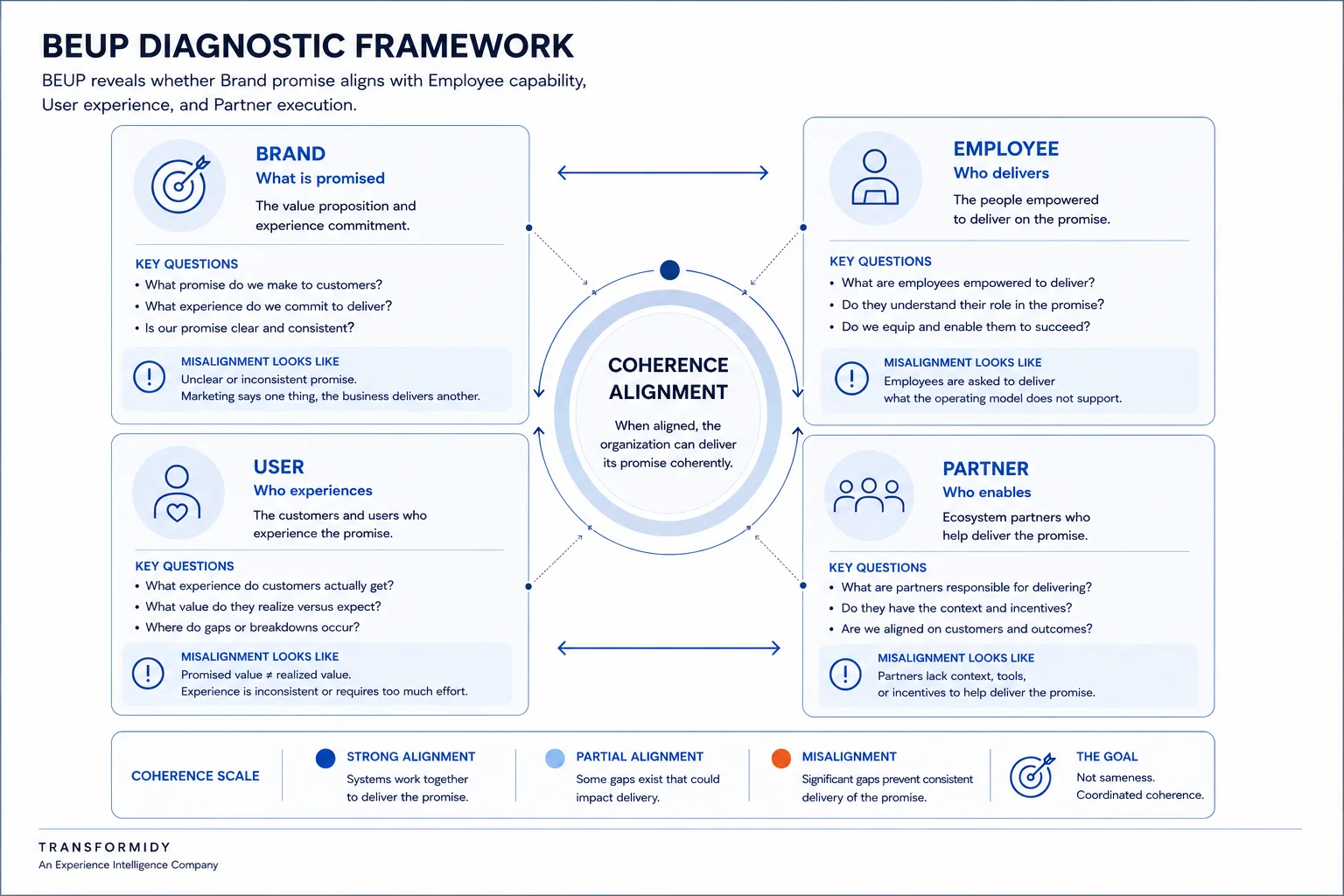
BEUP roles
BEUP starts with four realities that must stop contradicting each other.
BEUP diagnoses organizational alignment across Brand, Employee, User, and Partner. The acronym is useful only after the operating problem is clear: these realities must be integrated enough to create one coherent experience.
What you promise: the market expectation, trust claim, and strategic intent customers are asked to believe.
Who delivers it: the teams, incentives, tools, decisions, and recovery authority that turn promise into reality.
Who receives it: the customer, member, client, or stakeholder trying to make progress through the experience.
Who enables it: the ecosystem, supplier, channel, platform, and service partners that shape delivery quality.
Relationship alignment
The diagnosis happens in the relationships between the roles.
BEUP is not four labels placed beside each other. It tests whether the promise, delivery model, user reality, and partner ecosystem reinforce one another or create fragmentation.
Brand ↔ EmployeeBrand ↔ UserBrand ↔ PartnerEmployee ↔ UserEmployee ↔ PartnerUser ↔ Partner
Four dimensions
Better, Easier, Useful, and Preferred sit underneath the coherence diagnostic.
These four words remain important, but the page now treats BEUP as a system diagnostic first: does the organization have the alignment required to deliver the promise?
The experience improves the reality people are actually trying to move through.
The experience removes avoidable effort, restarts, confusion, and handoff drag.
The experience helps people make progress at the point of need.
The experience earns repeat choice because it is reliable, relevant, and trusted.
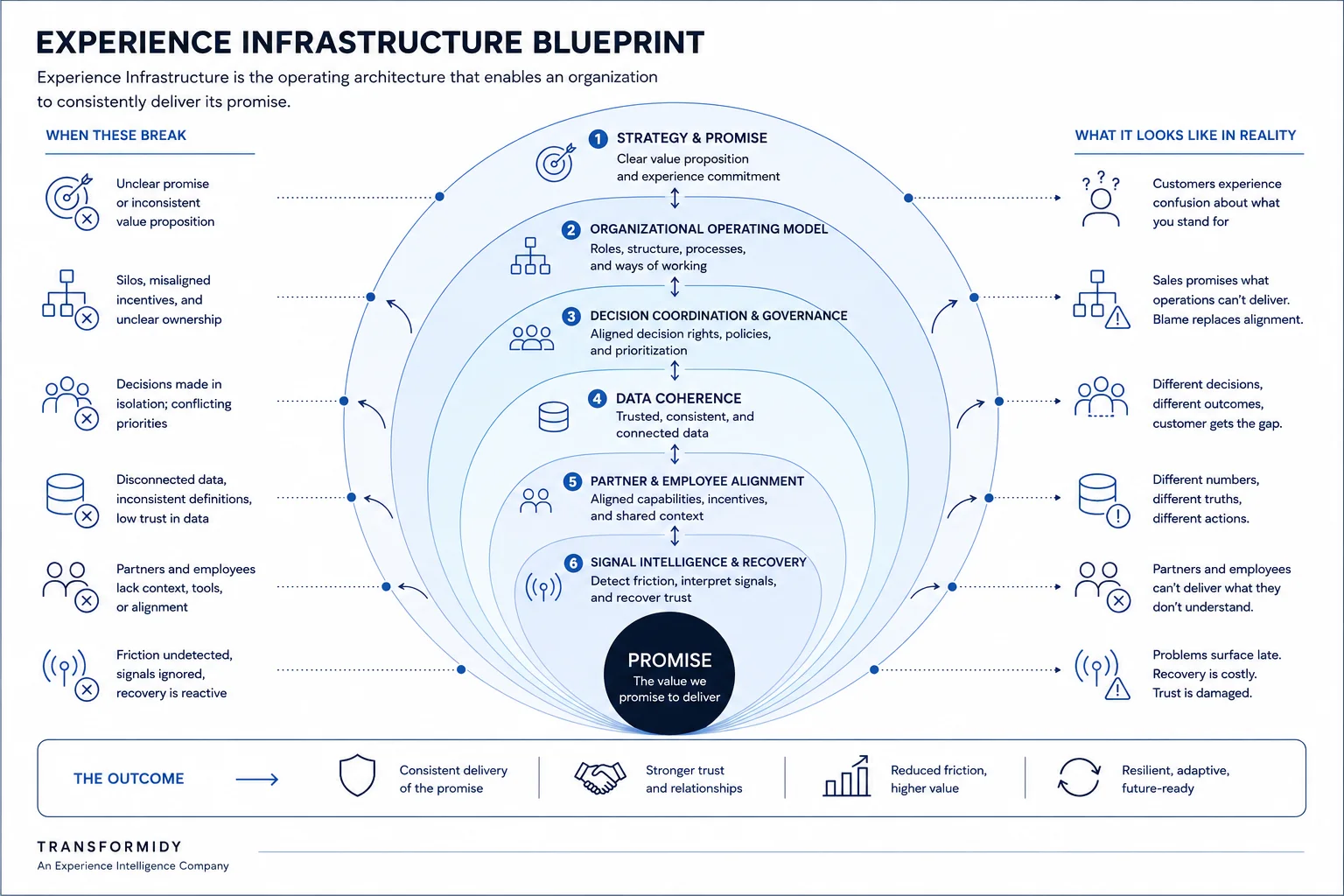
From theater to infrastructure
The value appears when the promise, system, and recovery model move together.
A better experience that is still hard to use, a useful experience that is not trusted, or an easier experience that fails the moment of need still creates friction. Experience Infrastructure makes the operating conditions visible before leaders optimize the surface.
Related problem
Revenue Friction
Use Revenue Friction to identify where brand, employee, user, and partner realities are producing commercial drag.
ContinueWhere BEUP fits
BEUP turns fragmentation into a clear alignment conversation.
The public sequence is simple: fragmentation exposes the problem, Experience Infrastructure defines the operating environment, BEUP diagnoses alignment, Revenue Friction reveals the cost, and Experience Intelligence turns signals into better decisions.
Related Frameworks
Follow the relationship between frameworks.
BEUP is the diagnostic lens. The related frameworks show what it reveals, what it points to, and how the system becomes coherent.
↓Diagnoses
Revenue Friction
Revenue Friction shows where BEUP gaps are creating commercial drag, customer effort, and recovery cost.
Read Revenue Friction↓Reveals
Fragmentation
Fragmentation is what BEUP makes visible when promises, teams, users, and partners stop reinforcing one another.
Read definition↓Operationalized through
Experience Infrastructure
Experience Infrastructure turns the BEUP diagnosis into operating design.
Read the framework↓Aims toward
Organizational Coherence
Organizational Coherence is the durable state BEUP is testing for across the whole system.
Read definition
Transformidy One handoff
Experience Infrastructure Discussion
- Purpose
- For BEUP, operating coherence, journey orchestration, recovery architecture, and experience infrastructure discussions.
- Operational service
- Live request-based scheduling at Transformidy One.
The live form records the relevant consent, source, and activity context for the selected newsletter or request path. Privacy and consent details remain available in the Transformidy Legal and Trust Center. Review privacy and consent.